
Books «Previous Next»

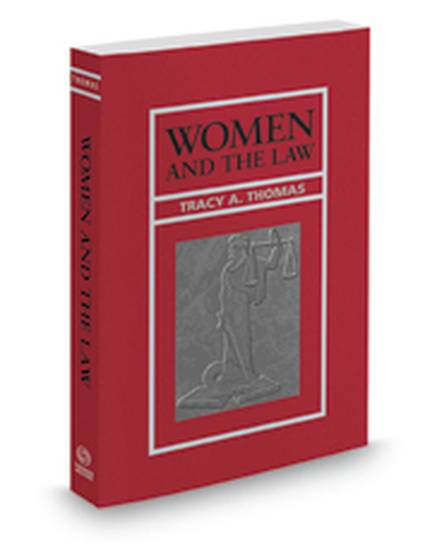
Women and the Law

Tracy A. Thomas, 1877

Abstract

A 2010 report on women in the United States recognized that women have come a long way, but still had a long way to go. “At one level, everything has changed. And yet so much more change is needed.” The Shriver Report, conducted by award-winning journalist Maria Shriver for the Center for American Progress, examined the need for societal change stemming from the emergence of working women as fully equal participants in the workforce. For the first time in our nation’s history, women are now half of all U.S. workers, and mothers are the primary breadwinners or co-breadwinners in nearly two-thirds of American families. This is a dramatic shift from just a generation ago, when in 1967 women made up only one-third of all workers. “Quite simply,” the Shriver Report concludes, “women as half of all workers changes everything.” It changes how women spend their days, and fundamentally changes how we all work, live, and exist within communities. “The battle of the sexes is over and is replaced by negotiations between the sexes about work, family, household responsibilities, child care, and elder care. Men and women agree that government and business are out of touch with the realties of how most families live and work today.” The report argues that families today need more flexible work schedules, comprehensive child care policies, redesigned family and medical leave, and equal pay for women.

A report by the Obama Administration reached a similar conclusion. The report, Women in America: Indicators of Social and Economic Well-Being (March 2011), was the first comprehensive statistical report on how women are faring in the United States since 1963, when the Commission on the Status of Women, established by President Kennedy and chaired by Eleanor Roosevelt, produced a report on the conditions of women. The Women in America report showed that women are working more, that the number of women and men in the labor force has equalized in recent years, and that women’s earnings constitute a growing share of family income. However, it found that gains in labor force involvement by women have not yet translated into wage and income equity. At all levels of education, women earned about 75 percent of what their male counterparts earned in 2009. Women are also more likely to be in poverty than men, in part because of this pay gap, but also because more women than men work part-time and because more unmarried and divorced women have responsibility for supporting their children. The report pointed out that “these economic inequities are even more acute for women of color.”

The evolving picture of women’s role in society may call for new approaches for countering sex discrimination. Legal action has been the vehicle in the past used to eradicate explicit barriers to women’s equal opportunity. This law reform continues today, for example in the Lilly Ledbetter Act of 2009, the first legislation signed into law by President Obama. The Act demonstrated public policy support for equal pay for women, reversing a U.S. Supreme Court decision in Ledbetter v. Goodyear Tire & Rubber Co. that barred claims for equal pay violations on grounds of statute of limitations. Yet broader proposals to address the pay gap between women and men, like the Paycheck Fairness Act introduced in 2009 by then-Senator Hillary Clinton, have been defeated.

This book collects material that explains the law’s unique intersection with issues that affect women. It previews the trends in the law and the issues dominating the courts and academic thinking. Women and the Law is not just about feminist theory or sex discrimination claims. It is about women’s full social experience from the private sphere of personal choice and family matters to the public sphere of the workplace. This book surveys the many legal issues confronting women and offers recommendations for advocating judicial and legislative change on their behalf.

Suggested Citation

Tracy A. Thomas, ed., Women and the Law (West 2011, 2012)


This document is currently not available here.

Share