
Article
8. Child witnesses and the Confrontation Clause.
Journal of Criminal Law & Criminology
(2012)
Abstract
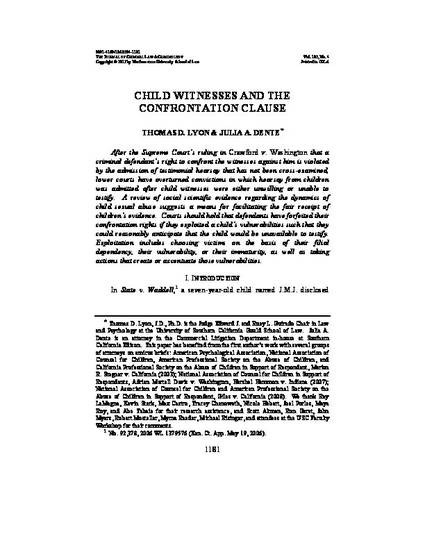
After the Supreme Court’s ruling in Crawford v. Washington that a criminal defendant’s right to confront the witnesses against him is violated by the admission of testimonial hearsay that has not been cross-examined, lower courts have overturned convictions in which hearsay from children was admitted after child witnesses were either unwilling or unable to testify. A review of social scientific evidence regarding the dynamics of child sexual abuse suggests a means for facilitating the fair receipt of children’s evidence. Courts should hold that defendants have forfeited their confrontation rights if they exploited a child’s vulnerabilities such that they could reasonably anticipate that the child would be unavailable to testify. Exploitation includes choosing victims on the basis of their filial dependency, their vulnerability, or their immaturity, as well as taking actions that create or accentuate those vulnerabilities.
Keywords
- child interviewing,
- child testimony,
- child abuse,
- child maltreatment,
- child witnesses,
- child neglect,
- child psychology,
- constitutional law,
- Confrontation Clause
Disciplines
Publication Date
May, 2012
Citation Information
8. Lyon, T. D., & Dente, J. (2012). Child witnesses and the Confrontation Clause. Journal of Criminal Law & Criminology, 102, 1181-1232.