
Article
The Foggy Road for Evaluating Punitive Damages: Lifting the Haze from the BMW/State Farm Guideposts
University of Michigan Journal of Law Reform
(2004)
Abstract
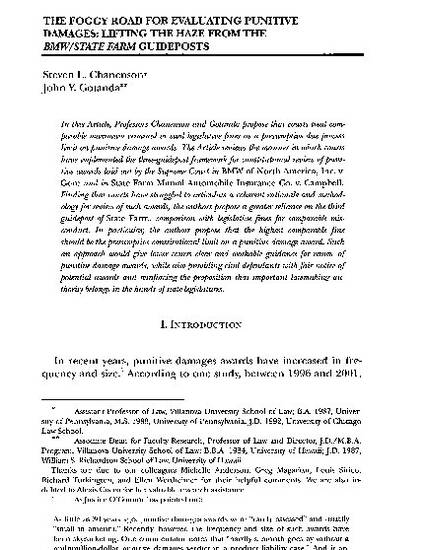
In light of increasing punitive damages awards, the United States Supreme Court formulated criteria for evaluating whether a punitive damages award is so unreasonably large that it violates substantive due process. Unfortunately, these "guideposts," which were first erected in BMW v. Gore and applied last term in State Farm v. Campbell, are difficult to use and have resulted in inconsistent decisions. Indeed, Justice Scalia stated that they "mark a road to nowhere." The authors argue that the problems with the guideposts can be fixed by refining the third guidepost, which compares the punitive damages award to the criminal (or civil) sanctions that could be imposed for comparable misconduct. To date, the Court's decisions have obfuscated this guidepost and, not surprisingly, it has largely been ignored by courts and commentators. The authors propose that courts, in applying the third guidepost, view comparable criminal (and civil) sanctions as a "presumptive limit" on punitive damages. This approach is consistent with the Court's views on the subject, satisfies the due process need for notice, is respectful of federalism concerns, and allows for greater proportionality and nuance while evaluating punitive damages awards. Most importantly, it should be easy to apply and result in more uniform decisions.
Disciplines
Publication Date
January, 2004
Citation Information
Steven L. Chanenson and John Y. Gotanda. "The Foggy Road for Evaluating Punitive Damages: Lifting the Haze from the BMW/State Farm Guideposts" University of Michigan Journal of Law Reform Vol. 37 (2004) p. 441 Available at: http://works.bepress.com/steven_chanenson/1/