
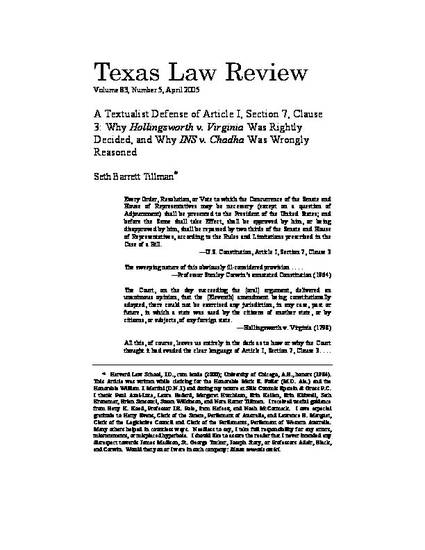
U.S. Constitution Article I, Section 7, Clause 3 reads:
Every Order, Resolution, or Vote to which the Concurrence of the Senate and House of Representatives may be necessary (except on a question of Adjournment) shall be presented to the President of the United States; and before the Same shall take Effect, shall be approved by him, or being disapproved by him, shall be repassed by two thirds of the Senate and House of Representatives, according to the Rules and Limitations prescribed in the Case of a Bill.
Madison, in his Notes on the Debates in the Federal Convention (Aug. 15 & Aug. 16, 1787), suggested it meant the following:
Every [bill by whatever name Congress calls it] to which the Concurrence of the Senate and House of Representatives may be necessary [because it has legislative effect] (except on a question of Adjournment) shall be presented to the President of the United States; and before the Same shall take Effect, shall be approved by him, or being disapproved by him, shall be repassed by two thirds of the Senate and House of Representatives, according to the Rules and Limitations prescribed in the Case of [other] Bill[s] [properly stylized when enacted per U.S. CONST. art. I, § 7, cl. 2].
Thus, this clause is usually called the residual presentment clause—or, the second presentment clause: it ensures presentment in spite of feared Madisonian legislative legerdemain attempting to manipulatively bypass the President’s veto, which is already provided for in the prior clause. See U.S. CONST. art. I, § 7, cl. 2 (the Presentment or Veto Clause).
I have good reason to believe Madison erred, or, more likely, modern courts and commentators have seriously misunderstood Madison’s Notes. In this paper, I put forward the view of a Commonwealth parliamentarian with whom I corresponded on this question. He is very well informed with regard to eighteenth century British and colonial parliamentary and administrative (treasury) practices. Indeed, my research relied extensively on contacts with foreign parliamentary officers, and legislative clerks & secretaries.
Every [final] Order, Resolution, or Vote [of a single house of Congress] to which the Concurrence of the Senate and House of Representatives may be necessary [as prior statutory authorization] (except on a question of Adjournment) shall be presented to the President of the United States; and before the Same shall take Effect [as a regulation per the prior organic act], shall be approved by him, or being disapproved by him, shall be repassed by two thirds of the Senate and House of Representatives, according to the Rules and Limitations prescribed in the Case of a Bill [which is a different case].
This (proposed) new meaning for Clause 3 stands our separation of powers jurisprudence on its head. It means the Supreme Court’s opinion in INS v. Chadha—broadly speaking—was fundamentally misconceived. Presentment is necessary, but not bicameralism, where single house orders are first authorized by a prior statute. At a deeper level, it means that our interpretive community—judges, legal academics, academics in related fields (government, political science, history, etc), and lawyers generally—have forgotten what a clause of the Constitution meant.
This article has been cited in over twenty journal articles, including articles appearing in peer reviewed journals (e.g., African Journal of Legal Studies, American Indian Law Review, British Journal of American Legal Studies, and Supreme Court Law Review), and in other elite law journals (e.g., Boston University Law Review, Duke Law Journal, Emory Law Journal, George Washington Law Review, Iowa Law Review, Northwestern University Law Review, Notre Dame Law Review, Stanford Law Review, Texas Law Review (two publications), UCLA Law Review (two publications), University of Pennsylvania Journal of Constitutional Law, Vanderbilt Law Review, William & Mary Law Review, and Yale Law Journal). Likewise, this article has been cited in over twenty books, case books, teachers’ manuals, treatises, doctoral dissertations and other student publications, think tank publications, conference papers, newsletters, annotations, and federal and state government documents.
Seth Barrett Tillman, A Textualist Defense of Article I, Section 7, Clause 3: Why Hollingsworth v. Virginia was Rightly Decided, and Why INS v. Chadha was Wrongly Reasoned, 83 TEX. L. REV. 1265 (2005).
Professor Gary Lawson, Comment, Burning Down the House (and Senate): A Presentment Requirement for Legislative Subpoenas Under the Orders, Resolutions, and Votes Clause, 83 TEX. L. REV. 1373 (2005).
Seth Barrett Tillman, The Domain of Constitutional Delegations Under the Orders, Resolutions, and Votes Clause: A Reply to Professor Gary Lawson, 83 TEX. L. REV. 1389 (2005).
[25 June 2015]
- orders,
- resolutions,
- votes,
- resolves,
- presentment,
- Hollingsworth,
- Chadha